
Alignment vs Performance: Why So Many High-Achieving People Feel Internally Divided
The hidden cost of living a life organized around external validation rather than internal coherence.
Many people who appear successful on the outside are quietly struggling on the inside. They are competent, responsible, and often highly capable. They meet expectations, fulfill their roles, and carry significant responsibility in their work, families, and communities. From the outside, their lives appear stable and productive. Yet internally, many describe a different experience. They feel pressure rather than clarity. They feel driven rather than grounded. They feel responsible for everything but connected to very little.
This internal tension is rarely discussed openly because performance culture rewards the appearance of stability. As long as someone continues producing results, few people ask whether that success is coming from alignment or from exhaustion.
The difference between those two states is profound. Performance-driven living organizes a person’s identity around outcomes. Value becomes connected to productivity, approval, or measurable results. Over time, this creates a subtle psychological contract: if performance remains strong, worth remains intact. But the human psyche is not designed to sustain that arrangement indefinitely.
When identity becomes tied to performance, several patterns begin to appear. People become highly sensitive to judgment and criticism. They begin to overextend themselves to maintain approval. Their decisions become reactive, driven more by pressure than by clarity. Eventually, many people realize they no longer feel connected to their own voice. They know what is expected of them, but they struggle to recognize what is truly aligned with their values and sense of self.
This is not a failure of discipline or motivation. It is a structural problem. Human beings function through an internal architecture that shapes perception, behavior, and relationships. When this architecture becomes distorted by constant external pressure, the individual begins to experience fragmentation. Different parts of their life move in different directions, creating tension and confusion.
Insight4Alignment describes this architecture through five core elements: identity, thought, dignity, trust, and presence.
Identity answers the question of who we understand ourselves to be.
Thought shapes how we interpret events and construct meaning.
Dignity determines whether we experience our voice and worth as intrinsic or conditional.
Trust shapes how we relate to others and navigate relationships.
Presence reflects the ability to act consciously rather than reactively.
When these elements align, life begins to feel coherent. Decisions come from clarity rather than pressure. Relationships become more authentic. Leadership shifts from control toward grounded influence. But when performance culture dominates a person’s environment, these structures often fall out of alignment.
Identity becomes defined by roles rather than by authentic values.
Thought patterns become reactive and defensive.
Dignity becomes conditional, dependent on validation.
Trust erodes as relationships become transactional.
Presence disappears as people move through life in a constant state of urgency.
At that point, success begins to feel strangely hollow. The person may still be performing well, but internally, they feel disconnected from themselves.
Alignment offers a different path. Rather than organizing life around performance, alignment focuses on restoring the internal architecture that allows individuals to live from coherence. When identity, thought, dignity, trust, and presence reconnect, performance no longer carries the weight of defining a person’s worth. Instead, action becomes an expression of alignment. Work becomes purposeful rather than exhausting. Leadership becomes relational rather than controlling. Growth becomes a process of discovering and expressing one’s deeper values rather than chasing external approval.
The shift from performance to alignment is not about abandoning responsibility or ambition. It is about relocating the source of motivation. Instead of asking, “What must I prove?” the aligned person begins asking, “What is true here, and how do I respond to it with integrity?” From that place, both personal and professional life begin to reorganize around coherence rather than pressure.
This is the heart of the Insight4Alignment approach. It is not a rejection of achievement. It is a restoration of the deeper architecture that makes achievement meaningful. When people begin rebuilding their internal architecture, performance no longer defines their worth. It simply becomes one expression of a life lived in alignment.
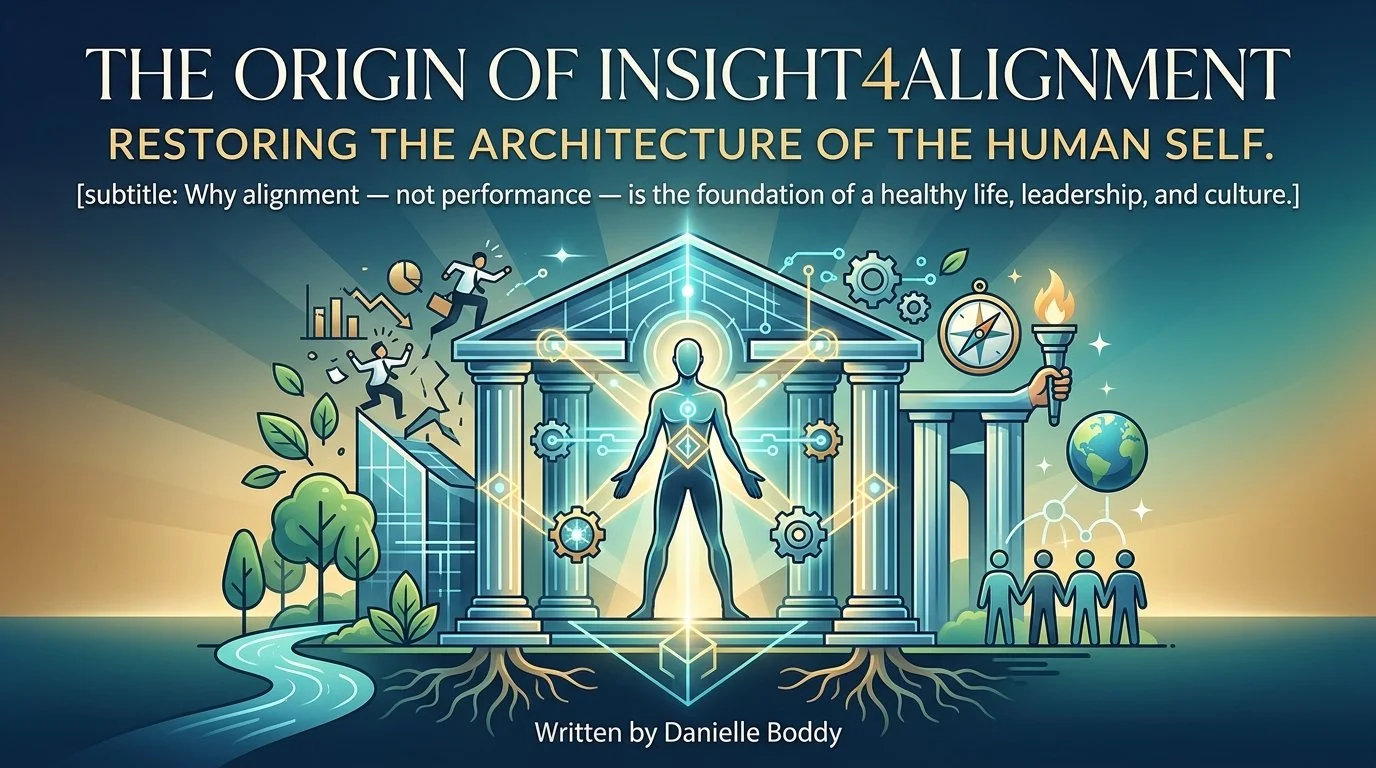
The Origin of Insight4Alignment: Restoring the Architecture of the Human Self
Why alignment — not performance — is the foundation of a healthy life, leadership, and culture.
For much of modern life, we have been taught to measure success through performance. Productivity, achievement, and external validation have become the primary indicators of whether a life is “working.” Yet many people discover that even when they meet those expectations, something inside still feels fragmented. They are capable, responsible, and often highly accomplished — but internally divided. Their decisions feel reactive rather than grounded. Their voice feels constrained by expectations. Their sense of worth fluctuates depending on approval, productivity, or external feedback. Over time, this produces a quiet but persistent dissonance. The problem is not a lack of effort or intelligence. The problem is misalignment.
Insight4Alignment was created to address that deeper condition. Rather than focusing primarily on productivity, performance strategies, or surface-level self-improvement, the Insight4Alignment framework explores something more fundamental: the internal architecture of the human person.
Every individual operates through an internal structure that shapes perception, decision-making, relationships, and leadership. When this architecture is coherent, life begins to feel grounded and intentional. When it becomes distorted or fragmented, people often experience confusion, reactivity, or exhaustion.
Through years of reflection, study, and coaching work, five core elements consistently emerged as the structural pillars of this architecture:
Identity — who we understand ourselves to be.
Thought — the narratives and interpretations shaping perception.
Dignity — the experience of intrinsic worth and voice.
Trust — the capacity to form healthy relationships with others and the world.
Presence — the ability to show up consciously and responsibly in the moment.
When these elements align, individuals experience a sense of internal coherence. Decisions feel clearer. Leadership becomes grounded rather than performative. Relationships grow more authentic. Life begins to feel less like a performance and more like an expression of one’s deeper values. But when these structures drift out of alignment, people often attempt to compensate through effort. They work harder. They try new strategies. They pursue additional achievements. Yet the underlying architecture remains unstable.
Insight4Alignment approaches transformation differently. Instead of simply teaching techniques or motivational strategies, the work focuses on rebuilding internal architecture. Through reflection, narrative exploration, coaching frameworks, and awareness practices, individuals begin to recognize the deeper structures shaping their lives. As these structures realign, behavior naturally changes. Leadership becomes less about control and more about presence. Personal growth becomes less about proving worth and more about expressing it. Culture shifts from performance pressure toward dignity and trust.
This is why Insight4Alignment extends beyond personal coaching. The same principles that shape individuals also shape teams, organizations, families, and communities. When identity, dignity, trust, and presence become foundational cultural values, organizations move from reactive management toward conscious leadership. Teams begin to collaborate rather than compete for validation. Communities begin to heal rather than fracture under pressure.
The goal of Insight4Alignment is not perfection. The goal is coherence. It is the quiet but powerful shift from living in reaction to living in alignment.
From this foundation, a broader ecosystem of learning and practice has developed — including the Thought Lab, Practice Lab, Inner Lab, and the narrative embodiment journey of Ink & Fire. Each of these spaces explores a different dimension of alignment, helping individuals reconnect with the deeper architecture of who they are and how they live. The work continues to evolve as more people begin asking the same essential question: What happens when we stop organizing life around performance and begin organizing it around alignment?
If this question resonates with you, the Thought Lab is a place to begin exploring the ideas and frameworks behind Insight4Alignment.