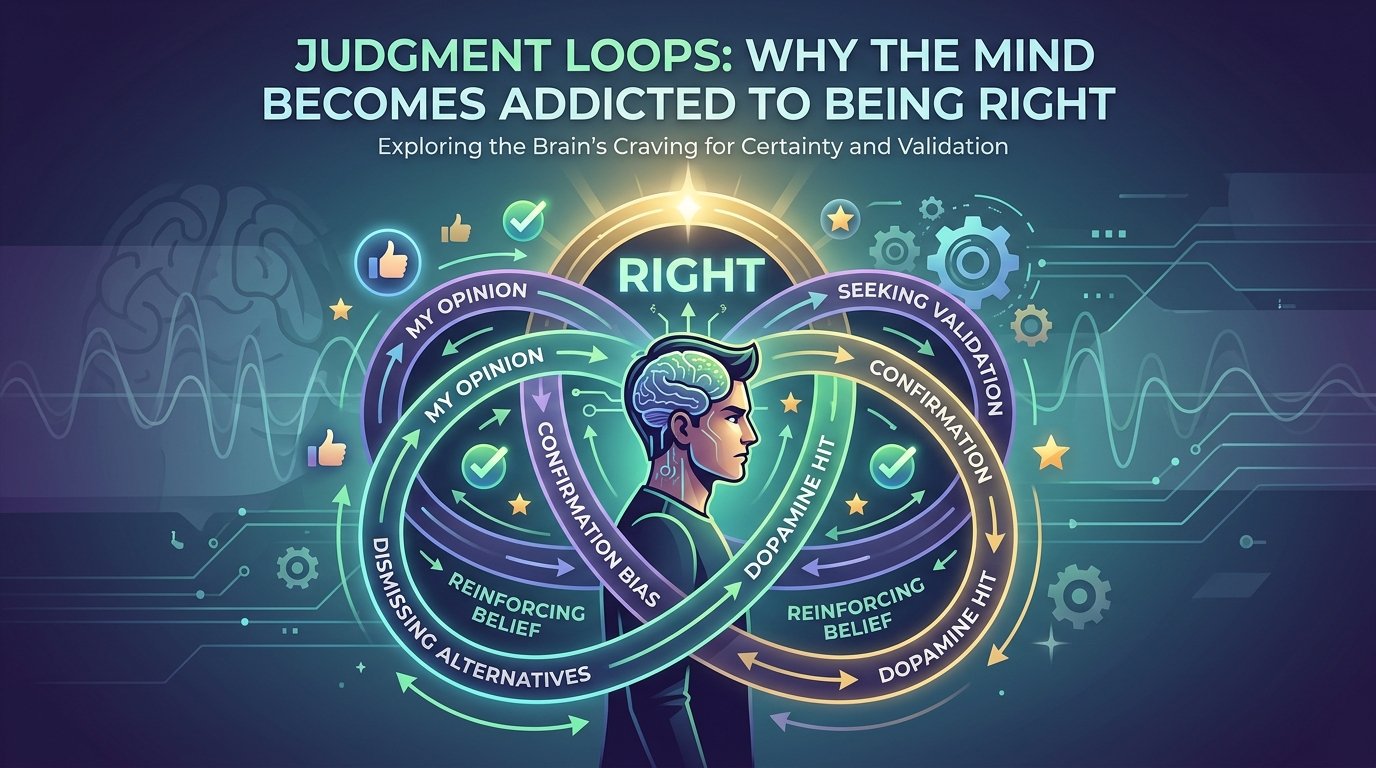
Judgment Loops: Why the Mind Becomes Addicted to Being Right
When the mind becomes attached to being right, it stops seeking truth and starts protecting identity — creating a psychological loop that fuels conflict, anxiety, and disconnection. At first glance, judgment feels like clarity. We see something and immediately label it: right or wrong, wise or foolish, acceptable or unacceptable. The mind feels certain. Stable. In control. However, beneath that certainty is often something much deeper — a psychological loop.
Why Certainty Feels So Good — and Costs So Much
When the mind becomes attached to being right, it stops seeking truth and starts protecting identity — creating a psychological loop that fuels conflict, anxiety, and disconnection. At first glance, judgment feels like clarity. We see something and immediately label it: right or wrong, wise or foolish, acceptable or unacceptable. The mind feels certain. Stable. In control. However, beneath that certainty is often something much deeper — a psychological loop.
Judgment is not always about truth. Very often, it is about identity protection. When our beliefs become fused with our sense of self, disagreement begins to feel like a threat. Instead of remaining curious, the mind begins defending its position. It gathers evidence, rejects opposing views, and reinforces the same conclusions over and over again.
This is what I call a Judgment Loop. A judgment loop is a cognitive pattern where the mind repeatedly seeks confirmation of its own correctness in order to stabilize identity and reduce internal uncertainty. Over time, the loop becomes addictive. Not because being right matters — but because certainty feels safe. The problem is that certainty can quietly replace awareness. And when awareness disappears, growth stops.
Key Insight
In the language of Alignment Architecture, judgment loops distort several internal structures at once:
• Thought Architecture becomes rigid
• Identity Architecture becomes defensive
• Dignity Architecture becomes conditional
• Trust Architecture begins to fracture
The result is a mind that feels powerful — but is actually trapped.
Freedom returns when curiosity replaces certainty.