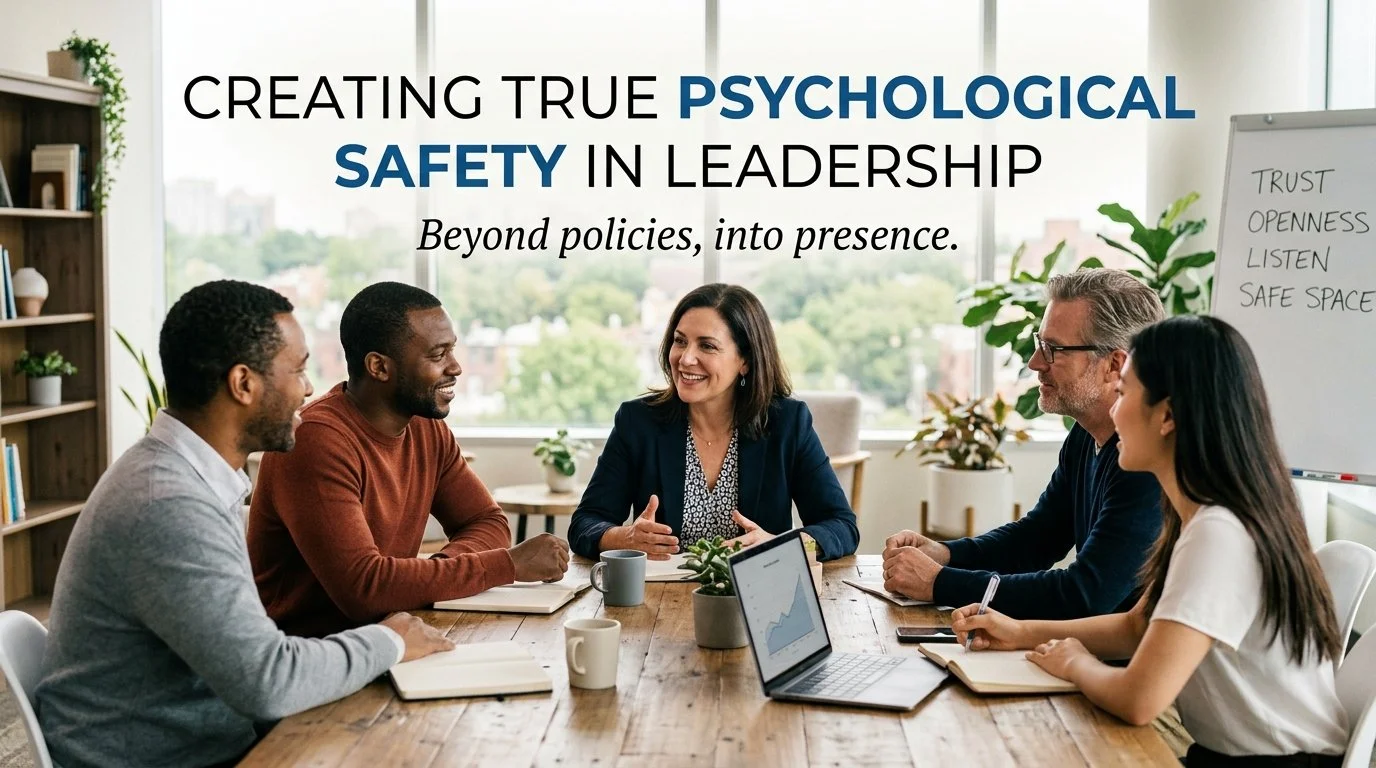
Creating True Psychological Safety in Leadership
Psychological safety has become one of the most talked-about concepts in leadership today. Yet despite its popularity, many organizations still struggle to create it in a way that is real, sustainable, and felt by their people. Why? It is because psychological safety is often treated as a policy or initiative, rather than a relational experience.
True psychological safety is not created through statements or training sessions alone. It is created through the daily posture of leadership—how a leader listens, responds, sets boundaries, and holds space for others.
Beyond policies, into presence
Psychological safety has become one of the most talked-about concepts in leadership today. Yet despite its popularity, many organizations still struggle to create it in a way that is real, sustainable, and felt by their people. Why? It is because psychological safety is often treated as a policy or initiative, rather than a relational experience. However, true psychological safety is not created through statements or training sessions alone. It is created through the daily posture of leadership—how a leader listens, responds, sets boundaries, and holds space for others. At its core, psychological safety is not about comfort. It is about trust. Too often, comfort has taken over the control center of how leaders define their culture.
What Psychological Safety Actually Requires
Leaders who create environments of true psychological safety consistently demonstrate:
Presence before reaction
They listen to understand, not to fix or control.Clarity over ambiguity
Expectations and standards are communicated with respect and consistency.Boundaries without punishment
Accountability is upheld without shame or fear-based control.Respect for emotional reality
People are allowed to express uncertainty, challenge ideas, and be in process.Consistency in conduct
Trust is built through repeated, aligned behavior—not occasional effort.
Psychological safety is not the absence of tension. It is the presence of relational integrity within tension.
Why Most Leadership Approaches Fall Short
Many leaders attempt to create safety by being more agreeable, more accommodating, or less directive. However, safety does not come from being “nice.” It comes from being clear, grounded, and trustworthy. Without structure, safety becomes fragile. Without presence, safety becomes performative. What is needed is a framework that helps leaders understand how their internal state and relational behavior shape culture.
The Role of Relational Leadership
This is where the Relational Leadership Diagnostic becomes essential. The diagnostic introduces leaders to a deeper question: How am I showing up in relationships—and what is that creating in others? Through this lens, leaders begin to see that culture is not built through strategy alone, but through:
Posture
Tone
Consistency
Awareness
Relational intelligence
This is the foundation of trust.
Introducing the Trust Culture Foundations Program
The Trust Culture Foundations Program was designed to help leaders move beyond theory and into applied relational leadership. This program equips leaders with the awareness and tools to:
Recognize how their leadership presence impacts trust
Develop clarity without losing connection
Lead conversations with integrity and emotional intelligence
Create environments where people can contribute fully without fear
It bridges the gap between intention and experience—because culture is not what leaders intend. It is what people consistently experience.
An Invitation to Lead Differently
If you are committed to building a culture where people feel safe to think, contribute, and grow, the work begins with awareness. We invite you to begin with the Relational Leadership Diagnostic and explore how your leadership presence is shaping your environment. From there, the Trust Culture Foundations Program will guide you into a deeper, more sustainable way of leading.
Psychological safety is not something you install. It is something you embody, and when leaders embody trust, culture follows.
Watch the Relational Leadership Diagnostic video here: https://youtu.be/hualmDF8Qv4.
Take the Trust Culture Foundations course for free by joining the AlignSpace Presence Community on Skool. The course is accessible through the Community Classroom.
Link: https://www.skool.com/alignspace-2699/about
Let’s connect!
Click on this link to learn more about Trust Culture Foundations: https://youtu.be/9emjx1p7LOo

When Curiosity Falls Silent
There once was a woman who had always believed herself to be a seeker. She asked questions. She read widely. She listened carefully to others. Curiosity had always felt like a companion walking beside her. However, over time, something changed. This wasn’t a sudden change. It was not dramatic. It was a change that came quietly.
Little by little, she began to notice that she no longer asked the same questions she once had. When someone spoke, she found herself finishing their sentences in her mind before they were done. When a new idea appeared, she compared it quickly to what she already believed. When conflict arose, she felt an urge to explain, defend, or correct rather than explore.
At first she told herself she was simply becoming wiser. After all, experience teaches us things. Surely, wisdom means being more certain. But something inside her felt tight. Conversations began to feel predictable. People seemed easier to categorize. Even the world felt smaller than it once had.
One evening, while walking along a quiet trail, she noticed an old woman sitting beside the path. The woman seemed calm, almost luminous in the fading light. The traveler stopped and greeted her.
After a moment of silence, the old woman asked gently, “Tell me, what question are you living inside these days?”
The traveler paused. She had many answers, but suddenly realized she could not name a single real question. She spoke instead about the problems she had been thinking about, the opinions she had formed, and the things she had concluded.
The old woman listened patiently. Then she asked again. “But what question is still alive in you?”
The traveler felt something shift. She realized that the voice inside her mind had been giving answers for a long time… but had stopped asking questions. Curiosity had not disappeared because the world had become simple. It had disappeared because certainty had become comfortable.
The old woman smiled kindly. “Certainty can feel safe,” she said. “But curiosity is what keeps the soul awake.”
The traveler stood quietly for a moment. She looked at the path ahead of her. For the first time in a long while, she did not feel the need to explain it, define it, or decide exactly where it would lead. She simply wondered. And in that wondering, something in her loosened. The world felt wide again.
Reflection
Where in your life has certainty replaced curiosity?
Where have your conclusions become stronger than your willingness to explore?
What question might be waiting quietly inside you, asking to be heard again?
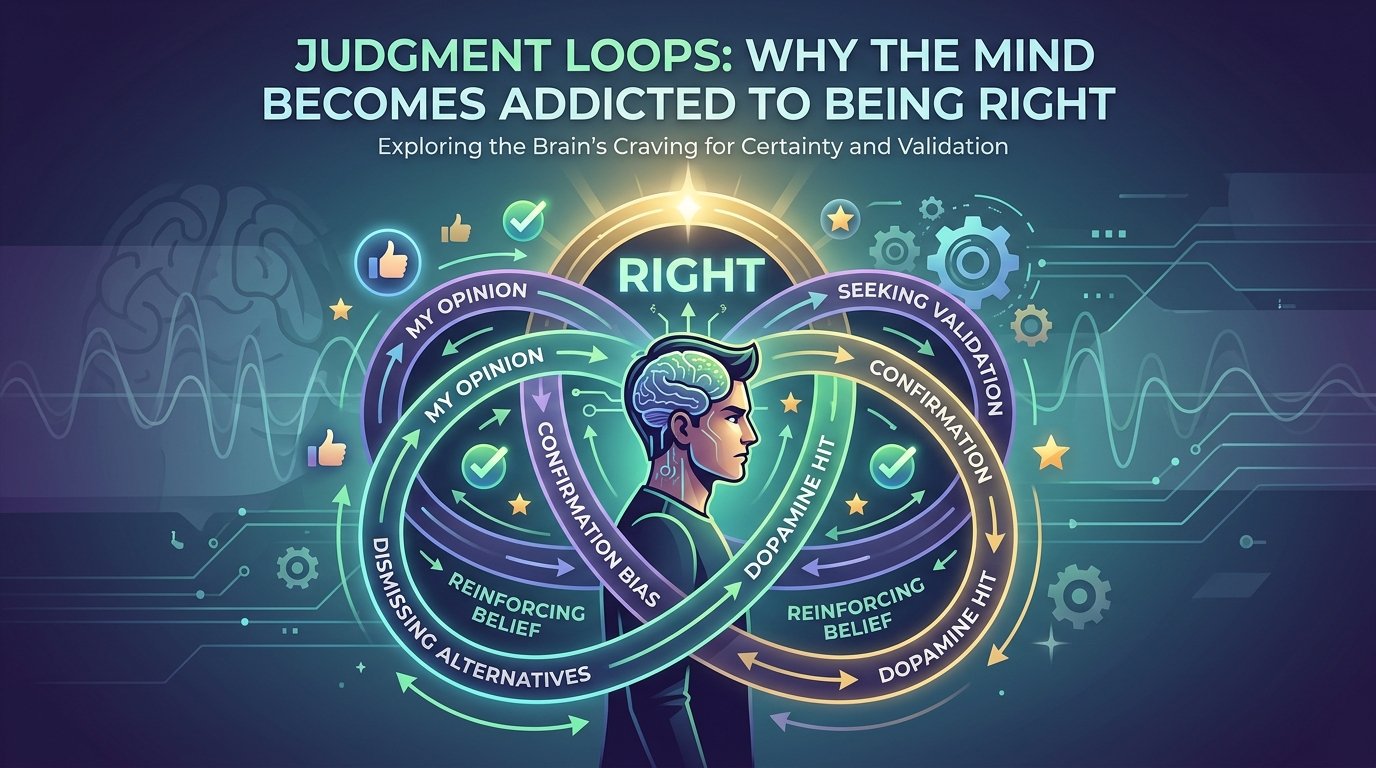
Judgment Loops: Why the Mind Becomes Addicted to Being Right
When the mind becomes attached to being right, it stops seeking truth and starts protecting identity — creating a psychological loop that fuels conflict, anxiety, and disconnection. At first glance, judgment feels like clarity. We see something and immediately label it: right or wrong, wise or foolish, acceptable or unacceptable. The mind feels certain. Stable. In control. However, beneath that certainty is often something much deeper — a psychological loop.
Why Certainty Feels So Good — and Costs So Much
When the mind becomes attached to being right, it stops seeking truth and starts protecting identity — creating a psychological loop that fuels conflict, anxiety, and disconnection. At first glance, judgment feels like clarity. We see something and immediately label it: right or wrong, wise or foolish, acceptable or unacceptable. The mind feels certain. Stable. In control. However, beneath that certainty is often something much deeper — a psychological loop.
Judgment is not always about truth. Very often, it is about identity protection. When our beliefs become fused with our sense of self, disagreement begins to feel like a threat. Instead of remaining curious, the mind begins defending its position. It gathers evidence, rejects opposing views, and reinforces the same conclusions over and over again.
This is what I call a Judgment Loop. A judgment loop is a cognitive pattern where the mind repeatedly seeks confirmation of its own correctness in order to stabilize identity and reduce internal uncertainty. Over time, the loop becomes addictive. Not because being right matters — but because certainty feels safe. The problem is that certainty can quietly replace awareness. And when awareness disappears, growth stops.
Key Insight
In the language of Alignment Architecture, judgment loops distort several internal structures at once:
• Thought Architecture becomes rigid
• Identity Architecture becomes defensive
• Dignity Architecture becomes conditional
• Trust Architecture begins to fracture
The result is a mind that feels powerful — but is actually trapped.
Freedom returns when curiosity replaces certainty.
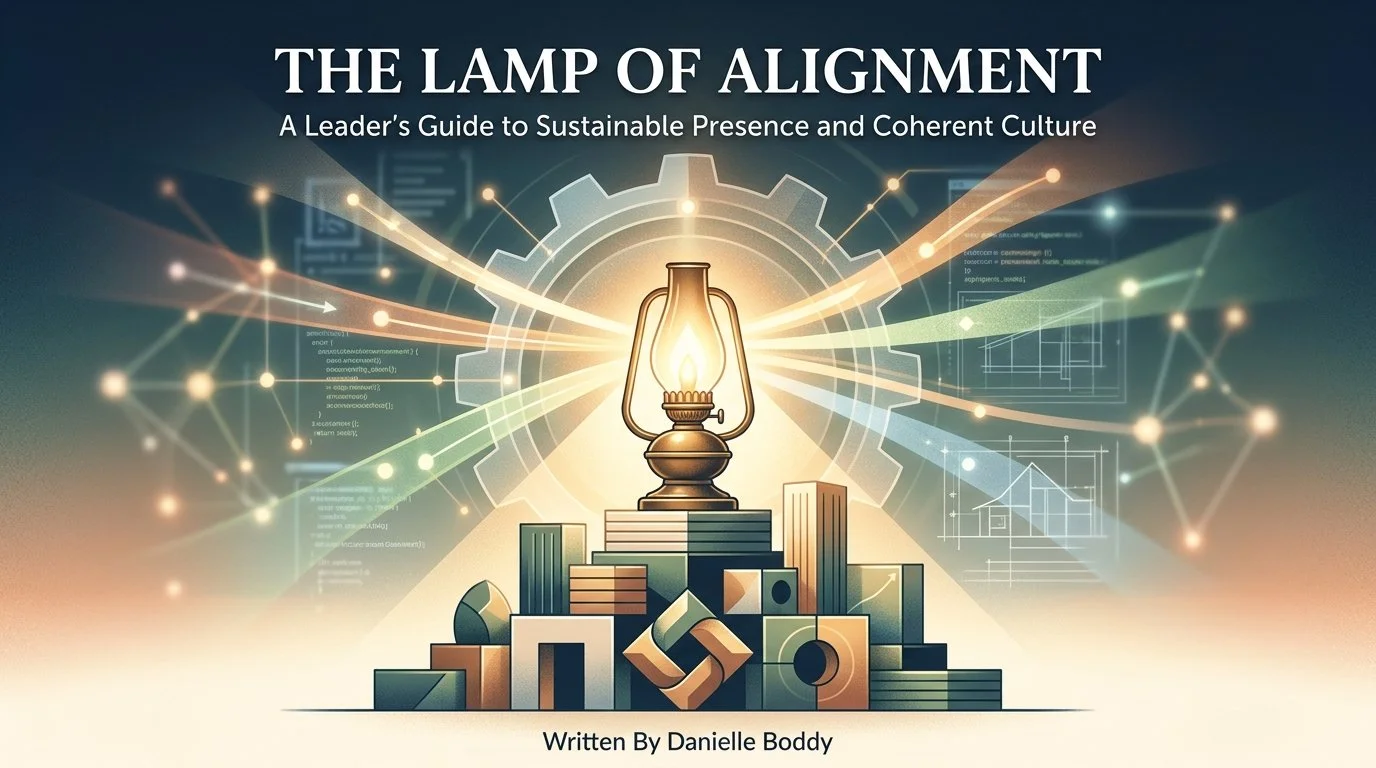
The Lamp of Alignment
Burnout is rarely a productivity problem. More often, it is a signal that something deeper has fallen out of alignment. Modern organizations are frequently designed around pressure, urgency, and measurable output. While these forces can produce short bursts of performance, they are not sustainable foundations for human vitality or meaningful work. Over time, teams that operate under constant pressure begin to experience depletion, fragmentation, and disengagement.
A Leader’s Guide to Sustainable Presence and Coherent Culture
Introduction
From Burnout to Alignment
Burnout is rarely a productivity problem. More often, it is a signal that something deeper has fallen out of alignment. Modern organizations are frequently designed around pressure, urgency, and measurable output. While these forces can produce short bursts of performance, they are not sustainable foundations for human vitality or meaningful work. Over time, teams that operate under constant pressure begin to experience depletion, fragmentation, and disengagement.
Insight4Alignment approaches leadership from a different premise. Human beings do not thrive under endless performance pressure. They thrive when the internal architecture of identity, dignity, trust, and presence is coherent. When that internal structure is aligned, individuals bring clarity, creativity, and resilience to their work. Teams become not only capable of producing results, but also capable of sustaining meaningful contribution over time.
At the heart of this approach is a guiding metaphor: The Lamp of Alignment. This lamp represents the living vitality of a team.
Within this metaphor:
The Flame represents the team’s energy, focus, and creative capacity.
The Oil represents shared wisdom, values, and relational trust.
The Wick represents the structures and systems that channel energy into meaningful work.
A healthy organization learns how to tend this lamp so that the flame can burn brightly without burning out. The first step in doing so is recognizing that burnout is not simply exhaustion. It is often a symptom of misalignment.
1. The Core Principle
Alignment Creates Coherence
Burnout frequently emerges when there is a gap between what people believe matters and what their work actually requires them to do. When values and actions diverge, people experience internal friction. Over time, this frictionbecomes fatigue.
Alignment restores coherence. In an aligned organization, the inner world of the team — its values, awareness, and sense of purpose moves in harmony with the outer world of projects, decisions, and results. This coherence can be understood through two dimensions.
The Inner World
Values
Awareness
Energy
Trust
The Outer World
Actions
Communication
Projects
Results
When these dimensions move together, the organization becomes coherent rather than reactive. A reactive team is constantly pulled in different directions by external demands. An aligned team moves with intention.
This shift from reaction to intention is not a soft concept. It produces tangible benefits:
• stronger decision-making
• lower turnover
• increased creativity
• greater resilience during uncertainty
Alignment creates a culture where people can contribute fully without sacrificing their well-being.
2. Pillar One
Cultivating the Inner Oil: Resilience Through Culture
A team’s resilience functions like oil within the lamp. It is the reservoir that allows energy to continue flowing even during seasons of difficulty. This oil is not created through occasional retreats or motivational speeches. It is built through daily practices that reinforce trust, reflection, and integrity.
Three practices are essential.
Reflection
Healthy teams create space to learn. Regular debriefs, thoughtful dialogue, and honest evaluation help prevent unresolved tensions from accumulating beneath the surface. Reflection keeps the team’s inner environment clear.
Compassion
Psychological safety allows people to show up as whole human beings rather than guarded performers. When individuals can acknowledge mistakes, ask for help, and support one another without fear of blame, the relational fabric of the team strengthens. Compassion is not weakness. It is the soil where trust grows.
Integrity
Integrity aligns words with actions. When leaders communicate transparently and make decisions consistent with the values they express, clarity replaces confusion. Integrity removes the ambiguity that often drains energy from teams.
Each act of courage, honesty, or responsibility quietly replenishes the oil of the organization.
3. Pillar Two
Tending the Flame: Rhythms of Sustainable Energy
A flame cannot be ignored until it flickers. It must be tended continuously. Sustainable performance grows from simple rhythms that protect the energy and focus of the team. Three practices are particularly powerful.
Presence
The most creative work happens in moments of genuine attention. Encouraging presence means protecting focused time, minimizing unnecessary interruptions, and cultivating awareness in meetings and collaboration. A present team produces better work with less strain.
Clarity
Confusion wastes energy. Leaders serve their teams by continually clarifying priorities, removing unnecessary complexity, and ensuring that each person understands how their work contributes to the whole. Clarity removes friction from the system.
Gratitude
Recognition restores meaning. When leaders acknowledge effort, creativity, and dedication with sincerity, they reinforce the shared purpose of the work. Gratitude reconnects people to why their contribution matters.
Together, these rhythms create an environment where energy circulates rather than drains.
4. Pillar Three
Turning Reflection into Action
Values only become real when they shape behavior. An aligned culture emerges when reflection and action reinforce one another. This requires leaders who consistently embody what they teach. Values must appear not only in mission statements, but in daily decisions. In hiring. In how mistakes are handled. In how success is defined.
When values are lived visibly, trust deepens and the culture begins to sustain itself. Each act of integrity, compassion, and courage strengthens the system. The lamp continues to burn.
5. The Role of the Leader
Becoming the Lamp
Leadership within an aligned culture is less about authority and more about coherence. A leader becomes luminous when their identity, words, and actions move in harmony. At that point, influence shifts. Instead of forcing energy into the system, the leader becomes a steady source of clarity and trust. In such environments, people begin to rediscover their own sense of purpose. They remember why their work matters. They feel safe enough to bring their full intelligence and creativity to the table. This is how leaders ignite others. Not by demanding performance, but by modeling alignment.
Conclusion
Cultivating Light from Within
Sustainable performance does not emerge from relentless external pressure. It grows from internal coherence. When identity, dignity, trust, and presence are integrated into the culture of a team, work becomes more than output. It becomes an expression of shared purpose and human dignity.
An aligned organization is not merely efficient. It is alive. And a living culture has the strength to illuminate challenges, inspire innovation, and endure through change. The leader’s task is not to create the light. It is to create the conditions where people remember that the light has always been within them.

The Architecture of Identity: Why Who You Believe You Are Shapes Everything
Explore how identity functions as an internal architecture shaping decisions, relationships, and leadership, and how rebuilding identity clarity restores alignment.
Understanding the internal structure that quietly directs your decisions, relationships, and leadership.
Most people think of identity as a label, a job title, a role in a family, a set of personality traits, or a list of experiences. These descriptions may reflect aspects of a person’s life, but they do not fully explain the deeper structure that shapes how a person moves through the world.
Identity is not simply something we describe. It is something we inhabit. The beliefs we hold about who we are quietly shape the way we interpret events, make decisions, and respond to challenges. Identity influences the boundaries we set, the opportunities we pursue, and the voices we listen to when navigating uncertainty. Because of this, identity functions less like a label and more like an internal architecture. It is the framework through which life is experienced.
When identity is grounded and coherent, people tend to experience a sense of stability. Their decisions reflect their values. Their actions align with their deeper convictions. They can navigate pressure without losing their voice. But when identity becomes fragmented, life begins to feel unstable. A person may move between different expectations depending on the environment they are in. At work, they become one version of themselves. At home, another. In moments of stress, they may default to patterns that no longer reflect who they want to be.
Over time, this creates a quiet tension. Many people describe feeling as though they are performing versions of themselves rather than living from a clear center. This fragmentation rarely happens suddenly. More often, it develops gradually through a lifetime of external influence. Cultural expectations, institutional structures, family narratives, and social pressures all shape the way individuals learn to see themselves.
In performance-driven environments, identity can slowly become tied to achievement. A person begins to understand themselves primarily through what they accomplish, how they are perceived, or whether they meet the expectations placed upon them. When that happens, identity becomes unstable. If worth is tied to performance, then moments of difficulty or criticism can begin to feel like threats to the self rather than growth opportunities. People may become highly productive but internally anxious, constantly trying to maintain the image they believe others expect.
The Insight4Alignment framework approaches identity differently. Rather than viewing identity as a static label, it recognizes identity as part of a larger internal structure that includes thought, dignity, trust, and presence. These elements work together to form the architecture through which individuals understand themselves and relate to the world. Identity sits at the center of this structure. It answers the fundamental question: Who am I, and from what place do I live and lead?
When identity becomes grounded in dignity rather than performance, people experience a different kind of stability. Their worth no longer fluctuates based on approval or outcomes. Instead, they begin to act from a deeper awareness of their values and voice. This does not eliminate challenges, but it changes how challenges are interpreted. Instead of seeing difficulty as evidence of personal inadequacy, aligned individuals begin to see challenges as opportunities to refine clarity and strengthen character. In this way, identity becomes less about defending an image and more about expressing an authentic center.
The work of rebuilding identity architecture requires reflection. People must learn to examine the narratives that have shaped their understanding of themselves and decide which ones are worth carrying forward. This process is not about constructing a new persona. It is about rediscovering the deeper architecture that has often been buried beneath years of expectation and adaptation.
When individuals reconnect with that architecture, the effects ripple outward. Thought patterns become more intentional. Dignity becomes grounded rather than conditional. Trust becomes relational rather than transactional. Presence becomes steady rather than reactive. Identity begins to function not as a mask but as a foundation. And from that foundation, a person can begin to live, lead, and contribute with clarity.
This is the beginning of alignment. When identity becomes aligned with dignity and conscious awareness, life no longer revolves around proving worth. It becomes an expression of who you are becoming.

Alignment vs Performance: Why So Many High-Achieving People Feel Internally Divided
The hidden cost of living a life organized around external validation rather than internal coherence.
Many people who appear successful on the outside are quietly struggling on the inside. They are competent, responsible, and often highly capable. They meet expectations, fulfill their roles, and carry significant responsibility in their work, families, and communities. From the outside, their lives appear stable and productive. Yet internally, many describe a different experience. They feel pressure rather than clarity. They feel driven rather than grounded. They feel responsible for everything but connected to very little.
This internal tension is rarely discussed openly because performance culture rewards the appearance of stability. As long as someone continues producing results, few people ask whether that success is coming from alignment or from exhaustion.
The difference between those two states is profound. Performance-driven living organizes a person’s identity around outcomes. Value becomes connected to productivity, approval, or measurable results. Over time, this creates a subtle psychological contract: if performance remains strong, worth remains intact. But the human psyche is not designed to sustain that arrangement indefinitely.
When identity becomes tied to performance, several patterns begin to appear. People become highly sensitive to judgment and criticism. They begin to overextend themselves to maintain approval. Their decisions become reactive, driven more by pressure than by clarity. Eventually, many people realize they no longer feel connected to their own voice. They know what is expected of them, but they struggle to recognize what is truly aligned with their values and sense of self.
This is not a failure of discipline or motivation. It is a structural problem. Human beings function through an internal architecture that shapes perception, behavior, and relationships. When this architecture becomes distorted by constant external pressure, the individual begins to experience fragmentation. Different parts of their life move in different directions, creating tension and confusion.
Insight4Alignment describes this architecture through five core elements: identity, thought, dignity, trust, and presence.
Identity answers the question of who we understand ourselves to be.
Thought shapes how we interpret events and construct meaning.
Dignity determines whether we experience our voice and worth as intrinsic or conditional.
Trust shapes how we relate to others and navigate relationships.
Presence reflects the ability to act consciously rather than reactively.
When these elements align, life begins to feel coherent. Decisions come from clarity rather than pressure. Relationships become more authentic. Leadership shifts from control toward grounded influence. But when performance culture dominates a person’s environment, these structures often fall out of alignment.
Identity becomes defined by roles rather than by authentic values.
Thought patterns become reactive and defensive.
Dignity becomes conditional, dependent on validation.
Trust erodes as relationships become transactional.
Presence disappears as people move through life in a constant state of urgency.
At that point, success begins to feel strangely hollow. The person may still be performing well, but internally, they feel disconnected from themselves.
Alignment offers a different path. Rather than organizing life around performance, alignment focuses on restoring the internal architecture that allows individuals to live from coherence. When identity, thought, dignity, trust, and presence reconnect, performance no longer carries the weight of defining a person’s worth. Instead, action becomes an expression of alignment. Work becomes purposeful rather than exhausting. Leadership becomes relational rather than controlling. Growth becomes a process of discovering and expressing one’s deeper values rather than chasing external approval.
The shift from performance to alignment is not about abandoning responsibility or ambition. It is about relocating the source of motivation. Instead of asking, “What must I prove?” the aligned person begins asking, “What is true here, and how do I respond to it with integrity?” From that place, both personal and professional life begin to reorganize around coherence rather than pressure.
This is the heart of the Insight4Alignment approach. It is not a rejection of achievement. It is a restoration of the deeper architecture that makes achievement meaningful. When people begin rebuilding their internal architecture, performance no longer defines their worth. It simply becomes one expression of a life lived in alignment.
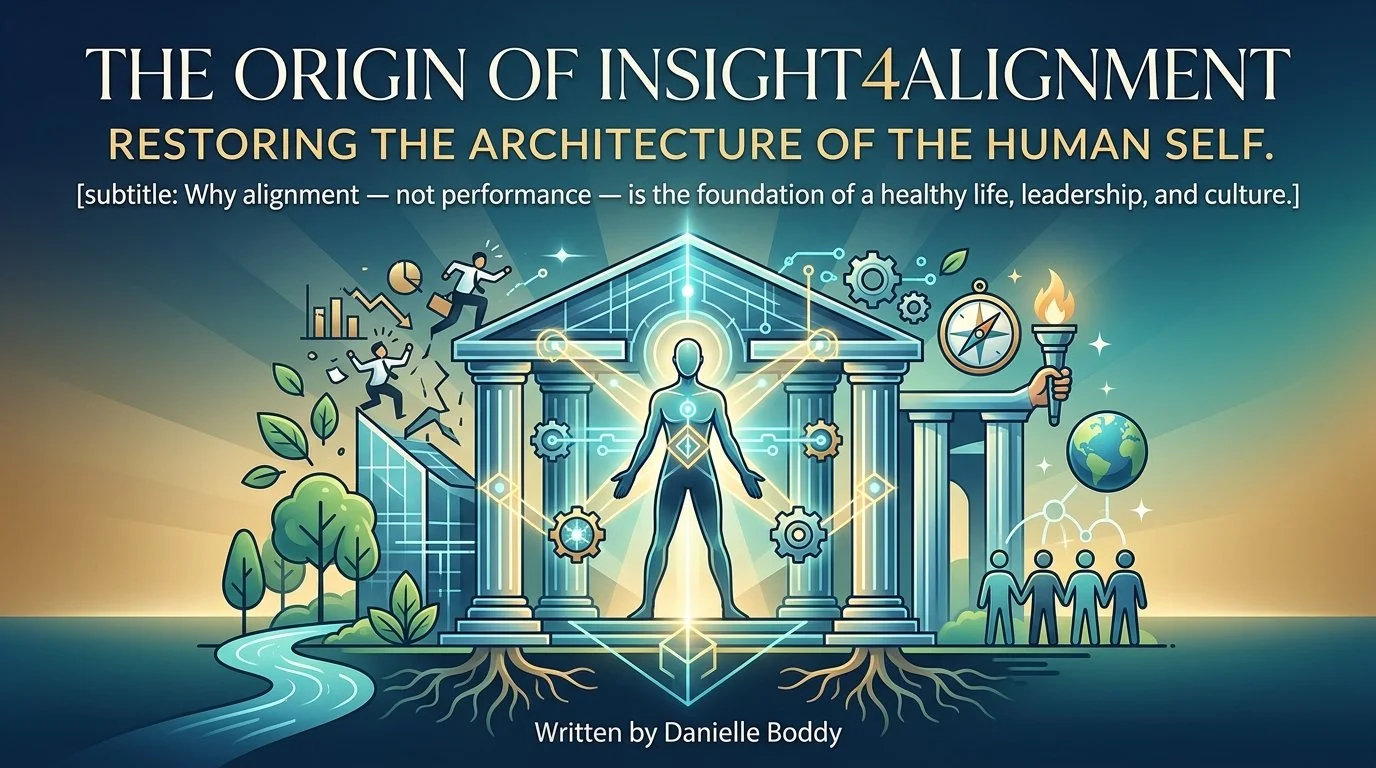
The Origin of Insight4Alignment: Restoring the Architecture of the Human Self
For much of modern life, we have been taught to measure success through performance. Productivity, achievement, and external validation have become the primary indicators of whether a life is “working.” Yet many people discover that even when they meet those expectations, something inside still feels fragmented. They are capable, responsible, and often highly accomplished — but internally divided. Their decisions feel reactive rather than grounded. Their voice feels constrained by expectations. Their sense of worth fluctuates depending on approval, productivity, or external feedback. Over time, this produces a quiet but persistent dissonance. The problem is not a lack of effort or intelligence. The problem is misalignment
Why alignment — not performance — is the foundation of a healthy life, leadership, and culture.
For much of modern life, we have been taught to measure success through performance. Productivity, achievement, and external validation have become the primary indicators of whether a life is “working.” Yet many people discover that even when they meet those expectations, something inside still feels fragmented. They are capable, responsible, and often highly accomplished — but internally divided. Their decisions feel reactive rather than grounded. Their voice feels constrained by expectations. Their sense of worth fluctuates depending on approval, productivity, or external feedback. Over time, this produces a quiet but persistent dissonance. The problem is not a lack of effort or intelligence. The problem is misalignment.
Insight4Alignment was created to address that deeper condition. Rather than focusing primarily on productivity, performance strategies, or surface-level self-improvement, the Insight4Alignment framework explores something more fundamental: the internal architecture of the human person.
Every individual operates through an internal structure that shapes perception, decision-making, relationships, and leadership. When this architecture is coherent, life begins to feel grounded and intentional. When it becomes distorted or fragmented, people often experience confusion, reactivity, or exhaustion.
Through years of reflection, study, and coaching work, five core elements consistently emerged as the structural pillars of this architecture:
Identity — who we understand ourselves to be.
Thought — the narratives and interpretations shaping perception.
Dignity — the experience of intrinsic worth and voice.
Trust — the capacity to form healthy relationships with others and the world.
Presence — the ability to show up consciously and responsibly in the moment.
When these elements align, individuals experience a sense of internal coherence. Decisions feel clearer. Leadership becomes grounded rather than performative. Relationships grow more authentic. Life begins to feel less like a performance and more like an expression of one’s deeper values. But when these structures drift out of alignment, people often attempt to compensate through effort. They work harder. They try new strategies. They pursue additional achievements. Yet the underlying architecture remains unstable.
Insight4Alignment approaches transformation differently. Instead of simply teaching techniques or motivational strategies, the work focuses on rebuilding internal architecture. Through reflection, narrative exploration, coaching frameworks, and awareness practices, individuals begin to recognize the deeper structures shaping their lives. As these structures realign, behavior naturally changes. Leadership becomes less about control and more about presence. Personal growth becomes less about proving worth and more about expressing it. Culture shifts from performance pressure toward dignity and trust.
This is why Insight4Alignment extends beyond personal coaching. The same principles that shape individuals also shape teams, organizations, families, and communities. When identity, dignity, trust, and presence become foundational cultural values, organizations move from reactive management toward conscious leadership. Teams begin to collaborate rather than compete for validation. Communities begin to heal rather than fracture under pressure.
The goal of Insight4Alignment is not perfection. The goal is coherence. It is the quiet but powerful shift from living in reaction to living in alignment.
From this foundation, a broader ecosystem of learning and practice has developed — including the Thought Lab, Practice Lab, Inner Lab, and the narrative embodiment journey of Ink & Fire. Each of these spaces explores a different dimension of alignment, helping individuals reconnect with the deeper architecture of who they are and how they live. The work continues to evolve as more people begin asking the same essential question: What happens when we stop organizing life around performance and begin organizing it around alignment?
If this question resonates with you, the Thought Lab is a place to begin exploring the ideas and frameworks behind Insight4Alignment.

Trust Culture
Trust Culture explores how leaders can build organizational environments rooted in dignity, curiosity, humility, and accountability rather than pressure and fear.
White Paper: Insight4Alignment Thought Lab
Building Leadership Environments Rooted in Dignity and Alignment
Executive Summary
Modern organizations often operate under intense performance pressure. Metrics, deadlines, and constant evaluation shape how success is measured and how individuals experience their work. While performance measurement is necessary for organizational effectiveness, it can unintentionally reshape workplace culture. When performance metrics become the primary lens for evaluating individuals, environments may begin to prioritize pressure, competition, and reaction over clarity, dignity, and intentional leadership.
The concept of Trust Culture offers an alternative framework.
Trust Culture describes leadership environments where dignity, accountability, humility, and curiosity shape how individuals interact and make decisions. Rather than relying primarily on pressure or fear-based motivation, these environments cultivate alignment between personal responsibility and organizational purpose.
This white paper explores how leaders can intentionally build cultures that support both performance and human dignity.
The Problem: Performance Without Trust
In many organizations, leaders focus heavily on outcomes without fully considering the cultural environment that produces those outcomes.
When pressure dominates the workplace environment, several patterns may emerge:
• Individuals become risk-averse
• Communication becomes guarded
• Mistakes are hidden rather than examined
• Creativity and initiative decrease
• Trust between leadership and employees erodes
In these environments, performance may continue temporarily, but the culture gradually becomes fragile. Employees may comply with expectations while disengaging emotionally from the work. Over time, organizations experience higher turnover, reduced innovation, and increasing internal friction.
This dynamic reflects a deeper structural problem: the absence of trust as a cultural foundation.
The Role of Trust in Organizational Health
Trust is not merely a positive workplace sentiment. It is a structural condition that influences how information flows, how decisions are made, and how individuals interpret leadership behavior. When trust exists within an organization, individuals are more likely to:
• Communicate openly about challenges
• Take responsible risks
• Learn from mistakes
• Collaborate across roles and departments
• Remain engaged with organizational goals
Trust does not eliminate accountability or performance expectations. Instead, it creates an environment where accountability can function effectively without generating fear or defensiveness. In this way, trust becomes a cultural infrastructure supporting both human well-being and organizational performance.
The Trust Culture Framework
Trust Culture within Insight4Alignment is built upon four foundational leadership practices.
Dignity
Leaders who cultivate trust recognize the inherent dignity of the individuals they lead. Dignity-centered leadership acknowledges that people are more than their current performance metrics. When dignity is respected, individuals are more likely to contribute authentically and take ownership of their work.
Humility
Humility allows leaders to remain open to feedback, new ideas, and the recognition that leadership itself is a learning process. Leaders who demonstrate humility create environments where employees feel safe raising concerns and contributing insight.
Brave Curiosity
Curiosity replaces defensiveness when problems arise. Rather than assigning immediate blame, leaders ask questions that help reveal the underlying dynamics of a situation. This encourages learning and continuous improvement.
Accountability
Trust does not eliminate responsibility. In fact, accountability becomes stronger in environments where trust is present. When individuals feel respected and supported, they are more likely to take responsibility for both successes and mistakes.
From Performance Culture to Alignment Culture
Trust Culture does not reject performance or productivity. Instead, it reorders the relationship between culture and outcomes. In performance-driven environments, pressure often becomes the primary driver of behavior. In trust-based environments, alignment becomes the driver. When individuals understand their role, feel respected within the culture, and trust leadership intentions, performance becomes a natural outcome of shared purpose rather than a reaction to external pressure.
Leadership as Cultural Architecture
Leaders do more than manage tasks or direct strategy. They shape the cultural environment in which people think, collaborate, and contribute. Every leadership decision communicates something about what the organization values. Over time, these signals accumulate to form the architecture of culture. Trust Culture invites leaders to recognize that culture is not accidental. It is something that can be intentionally designed and cultivated through consistent leadership behavior.
Applying the Trust Culture Model
Organizations seeking to develop a Trust Culture can begin with several foundational practices.
• Encourage open dialogue about challenges and mistakes
• Reward learning and improvement rather than only outcomes
• Model humility and curiosity at the leadership level
• Ensure accountability is balanced with dignity
These practices gradually shift the emotional climate of an organization. As trust increases, communication improves, collaboration strengthens, and individuals begin to operate with greater clarity and engagement.
Conclusion
Trust Culture represents an important shift in how leadership environments are understood. Rather than treating culture as a secondary concern behind performance metrics, this framework recognizes culture as the foundation that makes sustainable performance possible. When dignity, humility, curiosity, and accountability shape leadership behavior, organizations create environments where individuals can contribute fully without sacrificing their sense of identity or worth. In these environments, alignment between people and purpose becomes possible.
About Insight4Alignment
Insight4Alignment is a framework for rebuilding the internal and cultural structures that shape identity, thought, and decision-making. Through research, writing, programs, and leadership consulting, the work helps individuals and organizations move from reactive performance toward conscious alignment.
Work With Danielle Boddy
Danielle Boddy is the founder of Insight4Alignment and the developer of Alignment Architecture, the Alignment Method, and the Neuro-Alignment Method (NAM). Her work focuses on helping individuals and organizations rebuild the internal architecture that shapes identity, leadership, and decision-making.
Next Steps
Organizations interested in exploring the Trust Culture framework can learn more through leadership workshops, consulting engagements, and Thought Lab resources.
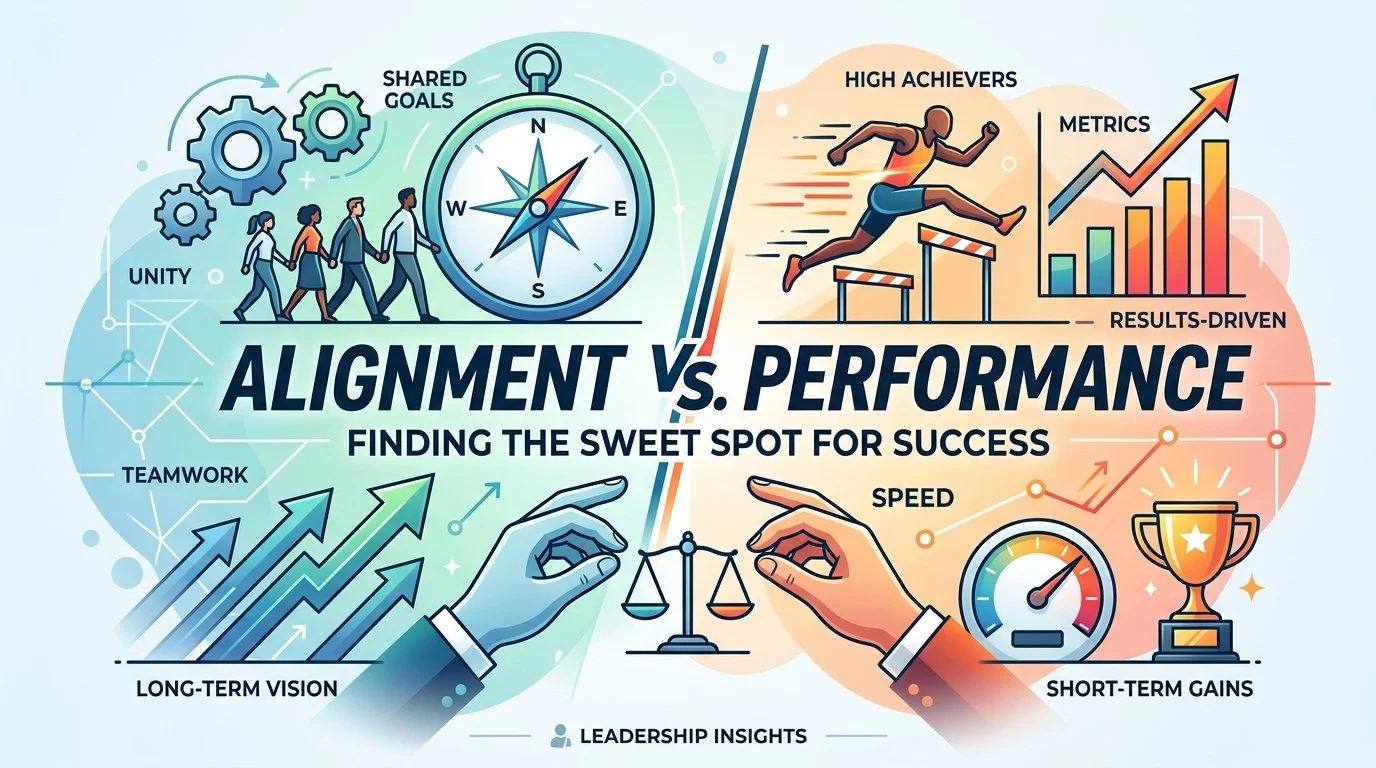
Alignment vs Performance
Many environments reward performance over alignment. This essay explores how reactive decision-making forms and how the Neuro-Alignment Method restores clarity and agency.
Why modern environments reward reaction rather than clarity
In many professional and social environments, success is measured by visible output: results, productivity, speed, and recognition. While these metrics can be useful for evaluating work, they often begin to influence something deeper—the way individuals understand themselves. Over time, people learn to organize their behavior around performance rather than alignment.
Performance asks: What will produce approval, recognition, or results?
Alignment asks: What action is consistent with identity, clarity, and integrity?
The difference between the two may appear subtle at first, but it shapes how decisions are made, how pressure is experienced, and how individuals relate to their own sense of worth.
The Culture of Reaction
Performance-based environments tend to reward speed and responsiveness. Individuals are expected to respond quickly to changing expectations, shifting goals, and external evaluation. While responsiveness can be valuable, it often encourages a pattern of reactive decision-making. Instead of pausing to consider whether an action aligns with deeper values or identity, individuals begin to prioritize immediate outcomes. Decisions become shaped by urgency, comparison, and external pressure. Over time, this pattern reinforces a subtle internal narrative: Your value depends on how well you respond to external demands.
The result is not simply increased productivity. It is the gradual replacement of internal clarity with external pressure.
Alignment Requires a Different Orientation
Alignment does not reject performance or responsibility. Work, excellence, and contribution remain important. What alignment changes is the source of action. When individuals operate from alignment, decisions begin with internal clarity rather than external pressure. Identity becomes the anchor that shapes behavior, rather than the byproduct of evaluation.
Aligned action tends to emerge from three internal conditions:
Clarity — understanding who one is becoming
Awareness — recognizing the narratives shaping decisions
Agency — choosing actions intentionally rather than reactively
When these conditions are present, performance becomes a natural outcome of alignment, rather than the primary goal.
Why Internal Narratives Matter
Much of the tension between alignment and performance occurs internally. Individuals carry narratives about responsibility, approval, success, and failure that quietly shape how they interpret situations. These narratives often form through years of cultural conditioning, professional expectations, or personal experience. Without examining these narratives, people may unknowingly continue operating from patterns that reinforce reaction rather than clarity.
This is why Insight4Alignment introduces the Neuro-Alignment Method.
The Neuro-Alignment Method helps individuals recognize internal narratives, interrupt reactive thinking patterns, and rebuild the relationship between identity, thought, and action.
Moving from Reaction to Conscious Action
Alignment begins when individuals learn to pause between stimulus and response. Instead of reacting automatically to external expectations, they begin to examine the internal narratives shaping their decisions. This shift does not reduce responsibility or performance. In many cases, it strengthens both. Individuals who operate from alignment tend to make decisions with greater consistency, integrity, and long-term clarity. The work is not about becoming less engaged with life—it is about becoming more intentional within it.
Practicing Alignment
Understanding the difference between alignment and performance is the first step. The next step is learning how to recognize and reshape the narratives that drive reactive thinking. The 21-Day Self-Talk Reset, part of the Neuro-Alignment Method, introduces practical exercises that help individuals examine internal narratives and rebuild the connection between identity, thought, and action. Through small daily practices, participants begin to replace reaction with awareness and external pressure with intentional decision-making.
Begin the Practice
If you would like to explore the practical side of this work, the 21-Day Self-Talk Reset introduces the foundations of the Neuro-Alignment Method.

When the Sacred Becomes a Metric
alignment-architecture-performance-culture.jpg
Alignment Architecture concept illustrating the shift from performance-driven identity to aligned living
In many modern environments—professional, cultural, and even personal—worth is increasingly measured through performance. Productivity dashboards, quarterly targets, social metrics, and constant evaluation quietly reshape how individuals understand themselves. Over time, these systems begin to influence something deeper than behavior: they begin to shape identity.
What begins as a method for tracking results slowly becomes a lens for measuring human value. This is the moment when the sacred becomes a metric.
The Quiet Conversion of Worth
Performance measurement is not inherently harmful. Organizations need feedback loops, and individuals benefit from clear goals. The problem emerges when measurement migrates from tools for evaluating work to standards for evaluating people. When that shift occurs, individuals begin to internalize a subtle message: Your worth must be proven.
In this environment, identity becomes tied to output, approval, and results. Effort replaces presence, and performance replaces clarity. Over time, people no longer simply do work—they begin to become their work.
The Psychological Cost of Metric-Based Identity
When identity becomes tied to performance metrics, several patterns begin to appear. Individuals may experience:
• Chronic self-evaluation
• Fear of failure or exposure
• Difficulty separating work from identity
• Exhaustion from constant proving
Rather than acting from internal clarity, decisions begin to emerge from pressure, comparison, and reaction. The result is not simply stress—it is a gradual distortion of the relationship between identity, thought, and action.
Rebuilding the Architecture of Alignment
Insight4Alignment approaches this problem from a structural perspective. Instead of focusing only on productivity or mindset, the work examines the internal architecture that shapes behavior.
Alignment emerges when four core elements are restored:
Identity — understanding who we are becoming
Thought — recognizing the narratives shaping decisions
Dignity — grounding worth beyond performance
Trust — building environments that support integrity
When these elements function together, individuals no longer operate primarily from external pressure. Decisions begin to arise from clarity, rather than reaction.
This is the foundation of Alignment Architecture.
From Performance to Presence
The solution to performance culture is not disengagement or apathy. Work and excellence still matter. What changes is the source of action. When individuals reconnect with dignity and internal clarity, effort no longer emerges from fear of failure or constant proving. Instead, it emerges from presence, responsibility, and conscious choice. The work remains meaningful—but the individual is no longer consumed by the need to justify their existence through performance.
The Beginning of the Alignment Journey
These ideas form the foundation of the Insight4Alignment framework and are explored in depth in the book:
When the Sacred Becomes a Metric
The book examines how performance culture reshapes identity and offers a framework for rebuilding the internal structures that support clarity, dignity, and aligned living. If the article resonated with you, the book expands these ideas and introduces the broader architecture behind the work.

The Architecture of Identity
Identity shapes how we interpret experience and make decisions. This essay explores identity architecture and how alignment begins with understanding who we are becoming.
Why alignment begins with understanding who we are becoming
Every decision a person makes emerges from some understanding of who they believe themselves to be. This understanding is rarely examined directly. It forms gradually through experience, relationships, cultural expectations, and the narratives individuals internalize about success, responsibility, and belonging. Over time, these influences shape what can be described as the architecture of identity.
Identity architecture refers to the internal structure that determines how individuals interpret situations, make decisions, and understand their place in the world. It is the lens through which thoughts form, behavior emerges, and meaning is assigned to experience. When this architecture is stable and intentional, individuals tend to move through life with clarity and direction. When it is fragmented or externally defined, decision-making often becomes reactive and inconsistent.
Alignment begins by understanding this structure.
Identity Is Not Static
Many people assume identity is something fixed—an unchanging description of personality or background. In reality, identity is dynamic.
It evolves through the interaction of several factors:
• Internal narratives about who we are
• Roles we occupy within families, organizations, and communities
• Cultural expectations and social feedback
• Personal values and aspirations
These elements continuously influence one another, shaping how individuals interpret their experiences. When identity is shaped primarily by external expectations, individuals may find themselves making decisions that reflect pressure rather than clarity. When identity is shaped intentionally, individuals begin making decisions from a clearer sense of who they are becoming.
The Relationship Between Identity and Thought
Identity does not operate independently from thought. The narratives individuals carry about themselves influence the way they interpret events, challenges, and opportunities. For example, a person who internally identifies as someone who must constantly prove their value may interpret neutral situations as evaluations of their worth. This can lead to patterns of overworking, perfectionism, or fear of failure. Another individual whose identity is grounded in dignity and purpose may interpret the same situation as an opportunity to contribute or learn. In both cases, the external situation may be identical. What differs is the identity architecture through which the situation is interpreted.
Rebuilding Identity Architecture
When individuals begin exploring alignment, they often focus first on behavior or productivity. While these areas matter, they rarely address the deeper structures that shape action. Insight4Alignment approaches this work differently. Instead of beginning with performance or output, the work begins by examining the internal architecture shaping decisions.
This process involves:
• Recognizing the narratives that influence identity
• Examining the roles individuals have internalized
• Clarifying personal values and direction
• Reconnecting identity with dignity rather than performance
When individuals rebuild identity architecture intentionally, behavior begins to change naturally. Actions become less reactive and more consistent with long-term direction.
Identity and Alignment
Alignment emerges when identity, thought, and action move in the same direction.
When identity is externally defined or fragmented, individuals may feel constant tension between what they do and who they feel they are supposed to be. When identity becomes intentional and grounded, decisions begin to feel less conflicted. Effort becomes more focused, and the relationship between responsibility and meaning becomes clearer. In this way, identity architecture forms the starting point of alignment.
Practicing Identity Alignment
Understanding identity conceptually is valuable, but meaningful change requires reflection and practice.
The 30-Day Identity Alignment program introduces structured exercises designed to help individuals examine the narratives shaping identity and begin rebuilding their internal architecture intentionally. Through guided reflection and practical exercises, participants learn to reconnect their decisions and actions with the person they are becoming.
Begin the Practice
If you would like to explore this work more deeply, the 30-Day Identity Alignment program offers a structured pathway for examining and rebuilding identity architecture.
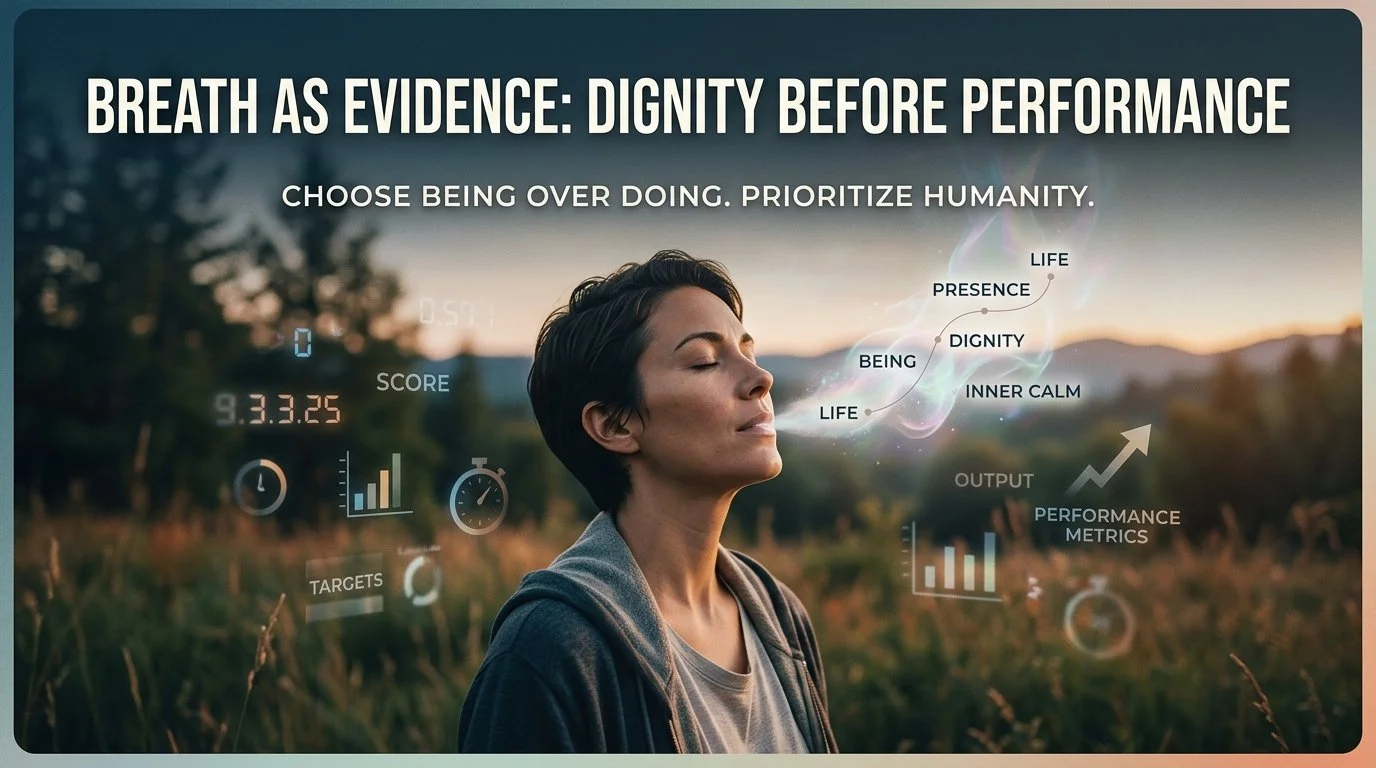
Breath as Evidence: Dignity Before Performance
Breath is the simplest evidence of belonging. This essay explores how restoring dignity before performance helps rebuild alignment in identity, thought, and action.
Restoring dignity before performance
Many people carry a quiet assumption about their worth: it must be earned. This assumption often forms gradually through cultural expectations, educational environments, professional systems, and personal experiences. Individuals learn—sometimes subtly and sometimes explicitly—that value must be proven through performance, productivity, or approval.
Over time, this belief becomes internalized. Instead of experiencing life as something to inhabit, individuals begin to experience life as something to justify. The result is a constant pressure to demonstrate competence, usefulness, or success in order to feel legitimate.
Insight4Alignment approaches this problem from a different starting point. Before performance, before achievement, before recognition, there is something far more fundamental. There is breath.
Breath as the First Evidence of Worth
Breath is the most basic sign of life. It requires no qualification, no certification, and no external validation. If a person is breathing, they are alive. If they are alive, their existence already carries inherent significance. This simple recognition challenges one of the most deeply embedded narratives in performance culture: that worth must be proven. Breath offers a different perspective. It reminds us that life itself precedes achievement. In this sense, breath becomes evidence—not of accomplishment, but of belonging.
When Worth Becomes Conditional
Performance-based environments often transform value into something conditional. Worth becomes tied to:
• Productivity
• Success
• Approval
• Comparison
• Visible outcomes
Under these conditions, individuals may begin to feel that rest, reflection, or uncertainty represent failure rather than natural parts of being human. The more someone internalizes this belief, the more difficult it becomes to separate identity from performance. Eventually, people may feel that they are only as valuable as their most recent success. This is one of the quiet costs of performance culture.
Restoring the Foundation of Dignity
Dignity is not something that emerges after success. It is the foundation from which healthy action becomes possible.
When individuals reconnect with dignity, effort begins to change in quality. Instead of acting primarily from fear of failure or the need for approval, individuals begin acting from a sense of responsibility, contribution, and clarity. Work still matters. Excellence still matters. What changes is the source of motivation. Actions begin to emerge from presence rather than pressure. This shift allows individuals to participate fully in their work and relationships without constantly measuring their value against external standards.
The Practice of Breath as Evidence
Understanding dignity intellectually is one step. Learning to experience it is another.
The Breath as Evidence practice invites individuals to pause long enough to recognize the simple reality that life itself is not something that must be justified. Through reflection, awareness exercises, and small daily practices, participants learn to interrupt the internal narrative that says worth must always be proven. The work is not about rejecting effort or ambition. Instead, it helps individuals rebuild the internal foundation from which effort can emerge in a healthier way. From that place, action becomes more intentional, relationships become more grounded, and the pressure to constantly prove one's existence begins to soften.
Living from Dignity Rather Than Proof
When individuals begin operating from dignity rather than proof, a quiet but profound shift occurs. They still contribute, still pursue meaningful goals, and still engage deeply with life. But the relationship between identity and performance changes. Work becomes an expression of life rather than a justification for it.
This is the beginning of alignment.
Begin the Practice
If you would like to explore this work in a structured way, the 21-Day Agency Restoration program introduces the core practices behind Breath as Evidence. Through guided exercises and reflection, participants begin rebuilding their relationship with dignity, agency, and intentional living.
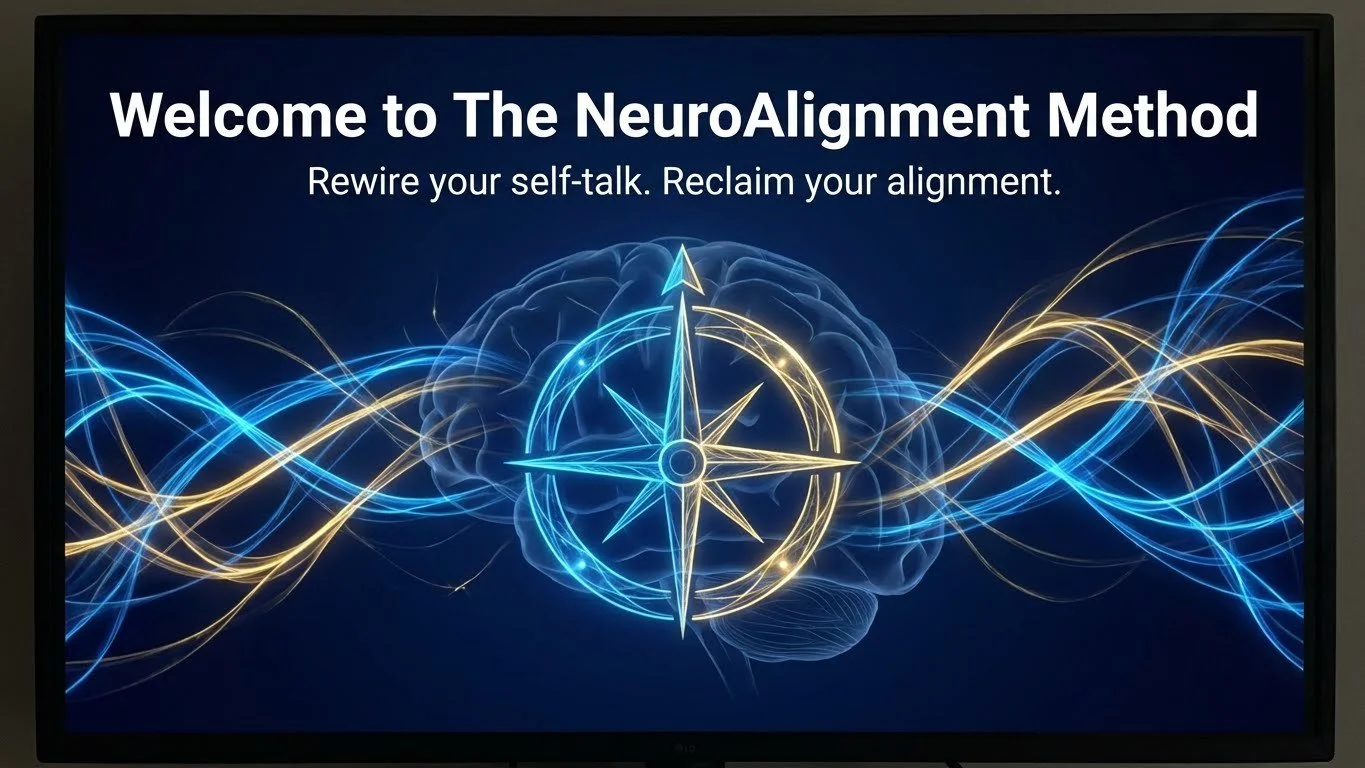
The Neuro-Alignment Method
The Neuro-Alignment Method helps individuals recognize internal narratives, interrupt reactive thinking patterns, and rebuild the relationship between identity, thought, and action.
Retraining the narratives that shape how we think and decide
Many people attempt to change their lives by focusing on behavior alone. They set new goals, adopt new habits, and push themselves toward greater productivity or discipline. While these efforts can produce short-term results, they often fail to address the deeper patterns shaping how decisions are made. Behind every action is a thought. Behind every thought is a narrative. And behind many of those narratives is an identity that was formed long before the current moment.
The Neuro-Alignment Method begins by examining these internal structures. Rather than focusing only on external behavior, the method helps individuals recognize the narratives and thought patterns that quietly shape how they interpret the world.
The Role of Internal Narratives
Human beings continuously interpret experience through internal stories. These narratives help us make sense of events, relationships, and expectations. Over time, they become automatic frameworks through which we evaluate ourselves and others. Some of these narratives support clarity and agency. Others reinforce pressure, fear, or the belief that worth must constantly be proven. Because these narratives operate largely beneath conscious awareness, individuals may continue repeating patterns long after the original conditions that created them have changed.
The Neuro-Alignment Method introduces practices that bring these narratives into awareness so they can be examined intentionally.
From Reaction to Awareness
One of the most important shifts in alignment occurs when individuals begin to recognize the space between stimulus and response. Without awareness, external pressures often trigger automatic reactions. People respond quickly to expectations, criticism, comparison, or uncertainty without examining the thoughts driving those reactions. When awareness increases, that automatic loop begins to loosen. Individuals start noticing the narratives that influence their interpretation of situations. Instead of reacting immediately, they gain the ability to pause, reflect, and choose a response more intentionally. This shift transforms decision-making. Actions begin to emerge from conscious reflection rather than conditioned reaction.
Rebuilding the Relationship Between Identity, Thought, and Action
The Neuro-Alignment Method works by reconnecting three elements that often become fragmented in performance-driven environments.
Identity
Thought
Action
When these elements drift apart, individuals may find themselves acting in ways that feel disconnected from who they believe themselves to be. Through structured reflection and guided practices, the method helps individuals bring these elements back into alignment. As this relationship strengthens, decisions become more consistent, internal conflict begins to decrease, and individuals gain a greater sense of agency over their choices.
The Practice of Self-Talk Awareness
One of the most accessible ways to begin this work is by examining self-talk. Self-talk represents the running dialogue individuals maintain with themselves throughout the day. It influences interpretation, emotional response, and behavioral choices. Because this dialogue often operates automatically, many people are unaware of how strongly it shapes their experience.
The Neuro-Alignment Method introduces practices that help individuals notice, question, and gradually reshape these internal conversations. Through consistent awareness, reactive patterns begin to weaken and intentional thinking becomes more natural.
The 21-Day Self-Talk Reset
The 21-Day Self-Talk Reset introduces the core practices of the Neuro-Alignment Method. Over three weeks, participants engage in small daily exercises designed to help them recognize internal narratives, interrupt reactive patterns, and rebuild the relationship between identity, thought, and action. The goal is not perfection or constant self-monitoring. Instead, the program helps individuals develop the awareness necessary to respond to life with greater clarity and intention. From that foundation, deeper alignment becomes possible.
Begin the Practice
If you would like to explore the Neuro-Alignment Method through guided exercises, the 21-Day Self-Talk Reset offers a structured introduction to the practices described here. Through daily reflection and awareness exercises, participants begin retraining the internal narratives that shape how they think, decide, and act.