Creating True Psychological Safety in Leadership
Psychological safety has become one of the most talked-about concepts in leadership today. Yet despite its popularity, many organizations still struggle to create it in a way that is real, sustainable, and felt by their people. Why? It is because psychological safety is often treated as a policy or initiative, rather than a relational experience.
True psychological safety is not created through statements or training sessions alone. It is created through the daily posture of leadership—how a leader listens, responds, sets boundaries, and holds space for others.
Beyond policies, into presence
Psychological safety has become one of the most talked-about concepts in leadership today. Yet despite its popularity, many organizations still struggle to create it in a way that is real, sustainable, and felt by their people. Why? It is because psychological safety is often treated as a policy or initiative, rather than a relational experience. However, true psychological safety is not created through statements or training sessions alone. It is created through the daily posture of leadership—how a leader listens, responds, sets boundaries, and holds space for others. At its core, psychological safety is not about comfort. It is about trust. Too often, comfort has taken over the control center of how leaders define their culture.
What Psychological Safety Actually Requires
Leaders who create environments of true psychological safety consistently demonstrate:
Presence before reaction
They listen to understand, not to fix or control.Clarity over ambiguity
Expectations and standards are communicated with respect and consistency.Boundaries without punishment
Accountability is upheld without shame or fear-based control.Respect for emotional reality
People are allowed to express uncertainty, challenge ideas, and be in process.Consistency in conduct
Trust is built through repeated, aligned behavior—not occasional effort.
Psychological safety is not the absence of tension. It is the presence of relational integrity within tension.
Why Most Leadership Approaches Fall Short
Many leaders attempt to create safety by being more agreeable, more accommodating, or less directive. However, safety does not come from being “nice.” It comes from being clear, grounded, and trustworthy. Without structure, safety becomes fragile. Without presence, safety becomes performative. What is needed is a framework that helps leaders understand how their internal state and relational behavior shape culture.
The Role of Relational Leadership
This is where the Relational Leadership Diagnostic becomes essential. The diagnostic introduces leaders to a deeper question: How am I showing up in relationships—and what is that creating in others? Through this lens, leaders begin to see that culture is not built through strategy alone, but through:
Posture
Tone
Consistency
Awareness
Relational intelligence
This is the foundation of trust.
Introducing the Trust Culture Foundations Program
The Trust Culture Foundations Program was designed to help leaders move beyond theory and into applied relational leadership. This program equips leaders with the awareness and tools to:
Recognize how their leadership presence impacts trust
Develop clarity without losing connection
Lead conversations with integrity and emotional intelligence
Create environments where people can contribute fully without fear
It bridges the gap between intention and experience—because culture is not what leaders intend. It is what people consistently experience.
An Invitation to Lead Differently
If you are committed to building a culture where people feel safe to think, contribute, and grow, the work begins with awareness. We invite you to begin with the Relational Leadership Diagnostic and explore how your leadership presence is shaping your environment. From there, the Trust Culture Foundations Program will guide you into a deeper, more sustainable way of leading.
Psychological safety is not something you install. It is something you embody, and when leaders embody trust, culture follows.
Watch the Relational Leadership Diagnostic video here: https://youtu.be/hualmDF8Qv4.
Take the Trust Culture Foundations course for free by joining the AlignSpace Presence Community on Skool. The course is accessible through the Community Classroom.
Link: https://www.skool.com/alignspace-2699/about
Let’s connect!
Click on this link to learn more about Trust Culture Foundations: https://youtu.be/9emjx1p7LOo
The Lamp of Alignment
Burnout is rarely a productivity problem. More often, it is a signal that something deeper has fallen out of alignment. Modern organizations are frequently designed around pressure, urgency, and measurable output. While these forces can produce short bursts of performance, they are not sustainable foundations for human vitality or meaningful work. Over time, teams that operate under constant pressure begin to experience depletion, fragmentation, and disengagement.
A Leader’s Guide to Sustainable Presence and Coherent Culture
Introduction
From Burnout to Alignment
Burnout is rarely a productivity problem. More often, it is a signal that something deeper has fallen out of alignment. Modern organizations are frequently designed around pressure, urgency, and measurable output. While these forces can produce short bursts of performance, they are not sustainable foundations for human vitality or meaningful work. Over time, teams that operate under constant pressure begin to experience depletion, fragmentation, and disengagement.
Insight4Alignment approaches leadership from a different premise. Human beings do not thrive under endless performance pressure. They thrive when the internal architecture of identity, dignity, trust, and presence is coherent. When that internal structure is aligned, individuals bring clarity, creativity, and resilience to their work. Teams become not only capable of producing results, but also capable of sustaining meaningful contribution over time.
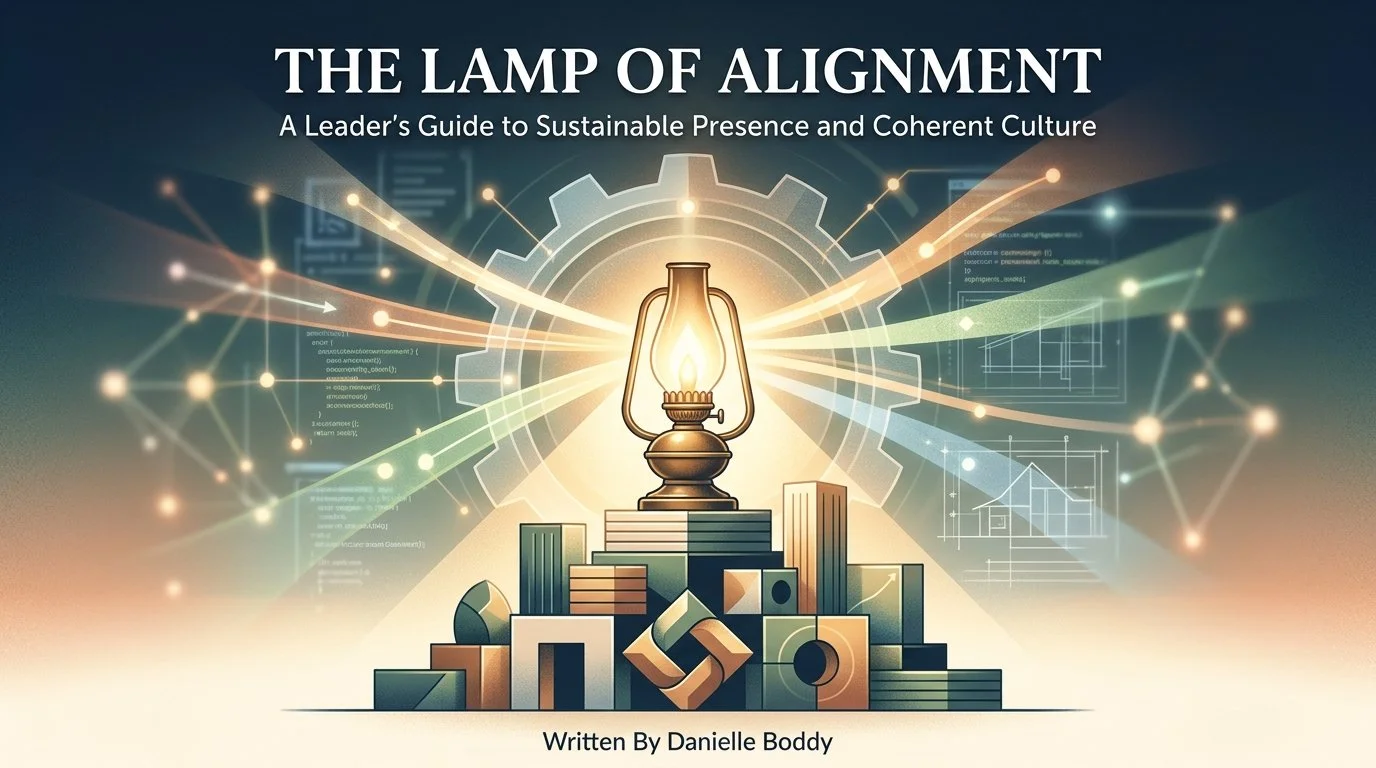
At the heart of this approach is a guiding metaphor: The Lamp of Alignment. This lamp represents the living vitality of a team.
Within this metaphor:
The Flame represents the team’s energy, focus, and creative capacity.
The Oil represents shared wisdom, values, and relational trust.
The Wick represents the structures and systems that channel energy into meaningful work.
A healthy organization learns how to tend this lamp so that the flame can burn brightly without burning out. The first step in doing so is recognizing that burnout is not simply exhaustion. It is often a symptom of misalignment.
1. The Core Principle
Alignment Creates Coherence
Burnout frequently emerges when there is a gap between what people believe matters and what their work actually requires them to do. When values and actions diverge, people experience internal friction. Over time, this frictionbecomes fatigue.
Alignment restores coherence. In an aligned organization, the inner world of the team — its values, awareness, and sense of purpose moves in harmony with the outer world of projects, decisions, and results. This coherence can be understood through two dimensions.
The Inner World
Values
Awareness
Energy
Trust
The Outer World
Actions
Communication
Projects
Results
When these dimensions move together, the organization becomes coherent rather than reactive. A reactive team is constantly pulled in different directions by external demands. An aligned team moves with intention.
This shift from reaction to intention is not a soft concept. It produces tangible benefits:
• stronger decision-making
• lower turnover
• increased creativity
• greater resilience during uncertainty
Alignment creates a culture where people can contribute fully without sacrificing their well-being.
2. Pillar One
Cultivating the Inner Oil: Resilience Through Culture
A team’s resilience functions like oil within the lamp. It is the reservoir that allows energy to continue flowing even during seasons of difficulty. This oil is not created through occasional retreats or motivational speeches. It is built through daily practices that reinforce trust, reflection, and integrity.
Three practices are essential.
Reflection
Healthy teams create space to learn. Regular debriefs, thoughtful dialogue, and honest evaluation help prevent unresolved tensions from accumulating beneath the surface. Reflection keeps the team’s inner environment clear.
Compassion
Psychological safety allows people to show up as whole human beings rather than guarded performers. When individuals can acknowledge mistakes, ask for help, and support one another without fear of blame, the relational fabric of the team strengthens. Compassion is not weakness. It is the soil where trust grows.
Integrity
Integrity aligns words with actions. When leaders communicate transparently and make decisions consistent with the values they express, clarity replaces confusion. Integrity removes the ambiguity that often drains energy from teams.
Each act of courage, honesty, or responsibility quietly replenishes the oil of the organization.
3. Pillar Two
Tending the Flame: Rhythms of Sustainable Energy
A flame cannot be ignored until it flickers. It must be tended continuously. Sustainable performance grows from simple rhythms that protect the energy and focus of the team. Three practices are particularly powerful.
Presence
The most creative work happens in moments of genuine attention. Encouraging presence means protecting focused time, minimizing unnecessary interruptions, and cultivating awareness in meetings and collaboration. A present team produces better work with less strain.
Clarity
Confusion wastes energy. Leaders serve their teams by continually clarifying priorities, removing unnecessary complexity, and ensuring that each person understands how their work contributes to the whole. Clarity removes friction from the system.
Gratitude
Recognition restores meaning. When leaders acknowledge effort, creativity, and dedication with sincerity, they reinforce the shared purpose of the work. Gratitude reconnects people to why their contribution matters.
Together, these rhythms create an environment where energy circulates rather than drains.
4. Pillar Three
Turning Reflection into Action
Values only become real when they shape behavior. An aligned culture emerges when reflection and action reinforce one another. This requires leaders who consistently embody what they teach. Values must appear not only in mission statements, but in daily decisions. In hiring. In how mistakes are handled. In how success is defined.
When values are lived visibly, trust deepens and the culture begins to sustain itself. Each act of integrity, compassion, and courage strengthens the system. The lamp continues to burn.
5. The Role of the Leader
Becoming the Lamp
Leadership within an aligned culture is less about authority and more about coherence. A leader becomes luminous when their identity, words, and actions move in harmony. At that point, influence shifts. Instead of forcing energy into the system, the leader becomes a steady source of clarity and trust. In such environments, people begin to rediscover their own sense of purpose. They remember why their work matters. They feel safe enough to bring their full intelligence and creativity to the table. This is how leaders ignite others. Not by demanding performance, but by modeling alignment.
Conclusion
Cultivating Light from Within
Sustainable performance does not emerge from relentless external pressure. It grows from internal coherence. When identity, dignity, trust, and presence are integrated into the culture of a team, work becomes more than output. It becomes an expression of shared purpose and human dignity.
An aligned organization is not merely efficient. It is alive. And a living culture has the strength to illuminate challenges, inspire innovation, and endure through change. The leader’s task is not to create the light. It is to create the conditions where people remember that the light has always been within them.