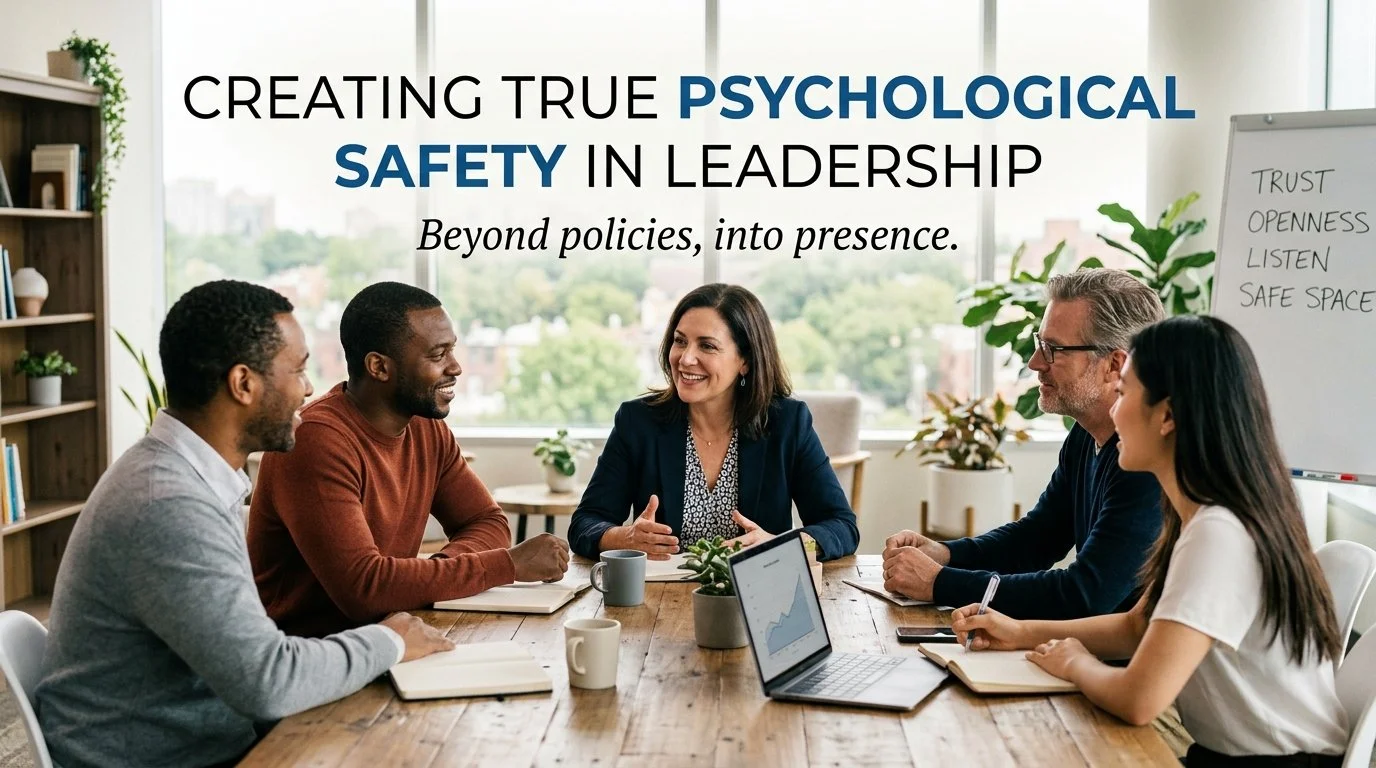
Creating True Psychological Safety in Leadership
Psychological safety has become one of the most talked-about concepts in leadership today. Yet despite its popularity, many organizations still struggle to create it in a way that is real, sustainable, and felt by their people. Why? It is because psychological safety is often treated as a policy or initiative, rather than a relational experience.
True psychological safety is not created through statements or training sessions alone. It is created through the daily posture of leadership—how a leader listens, responds, sets boundaries, and holds space for others.
Beyond policies, into presence
Psychological safety has become one of the most talked-about concepts in leadership today. Yet despite its popularity, many organizations still struggle to create it in a way that is real, sustainable, and felt by their people. Why? It is because psychological safety is often treated as a policy or initiative, rather than a relational experience. However, true psychological safety is not created through statements or training sessions alone. It is created through the daily posture of leadership—how a leader listens, responds, sets boundaries, and holds space for others. At its core, psychological safety is not about comfort. It is about trust. Too often, comfort has taken over the control center of how leaders define their culture.
What Psychological Safety Actually Requires
Leaders who create environments of true psychological safety consistently demonstrate:
Presence before reaction
They listen to understand, not to fix or control.Clarity over ambiguity
Expectations and standards are communicated with respect and consistency.Boundaries without punishment
Accountability is upheld without shame or fear-based control.Respect for emotional reality
People are allowed to express uncertainty, challenge ideas, and be in process.Consistency in conduct
Trust is built through repeated, aligned behavior—not occasional effort.
Psychological safety is not the absence of tension. It is the presence of relational integrity within tension.
Why Most Leadership Approaches Fall Short
Many leaders attempt to create safety by being more agreeable, more accommodating, or less directive. However, safety does not come from being “nice.” It comes from being clear, grounded, and trustworthy. Without structure, safety becomes fragile. Without presence, safety becomes performative. What is needed is a framework that helps leaders understand how their internal state and relational behavior shape culture.
The Role of Relational Leadership
This is where the Relational Leadership Diagnostic becomes essential. The diagnostic introduces leaders to a deeper question: How am I showing up in relationships—and what is that creating in others? Through this lens, leaders begin to see that culture is not built through strategy alone, but through:
Posture
Tone
Consistency
Awareness
Relational intelligence
This is the foundation of trust.
Introducing the Trust Culture Foundations Program
The Trust Culture Foundations Program was designed to help leaders move beyond theory and into applied relational leadership. This program equips leaders with the awareness and tools to:
Recognize how their leadership presence impacts trust
Develop clarity without losing connection
Lead conversations with integrity and emotional intelligence
Create environments where people can contribute fully without fear
It bridges the gap between intention and experience—because culture is not what leaders intend. It is what people consistently experience.
An Invitation to Lead Differently
If you are committed to building a culture where people feel safe to think, contribute, and grow, the work begins with awareness. We invite you to begin with the Relational Leadership Diagnostic and explore how your leadership presence is shaping your environment. From there, the Trust Culture Foundations Program will guide you into a deeper, more sustainable way of leading.
Psychological safety is not something you install. It is something you embody, and when leaders embody trust, culture follows.
Watch the Relational Leadership Diagnostic video here: https://youtu.be/hualmDF8Qv4.
Take the Trust Culture Foundations course for free by joining the AlignSpace Presence Community on Skool. The course is accessible through the Community Classroom.
Link: https://www.skool.com/alignspace-2699/about
Let’s connect!
Click on this link to learn more about Trust Culture Foundations: https://youtu.be/9emjx1p7LOo